
So as you know during the first 2 weeks of school at LLU, the medical students are in the hospital. They split us up randomly in terms of what service each student would be in, and I was put in the Pediatric Intensive Care Unit (PICU). So how has my week been? I guess I could describe it as mostly saddening and boring. Its not that I hate pediatrics or kids; I actually learned that I have a really soft spot in my heart for kids in the hospital. What I do hate is ROUNDS. I HATE ROUNDS. I come in at 8 a.m., and we round almost the whole day. The first problem with rounds is that we are standing the whole time; the second problem with rounds is that at this point in my training, I have absolutely no idea what the 4th years and residents are saying when they present their patients; the 3rd thing that I hate about rounds is that I have to wear a shirt, slacks, and a TIE; the 4th thing I hate about rounds, especially PICU rounds is that we stand outside the door and talk about the care of the patient. We barely go in, or “DO” anything during rounds, but we sure do talk about them. Yesterday after rounds, I was sure that my feet were going to fall off of my ankles. I was sure that rounds were a tool of the devil, as is research; but a purchase I made at the Sports Authority last night changed everything:
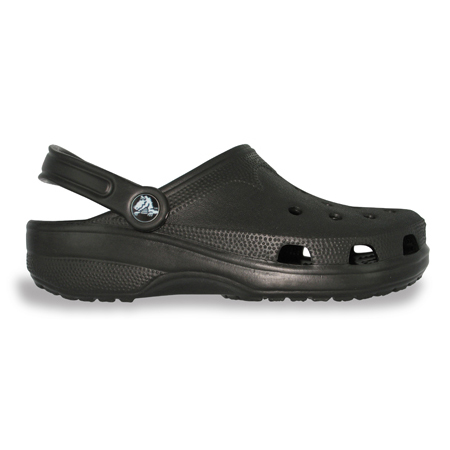
Crocs…yes crocs are truly the best thing since sliced bread. Yes I still had a shirt and tie on, but today, my feet…felt so GOOD! We rounded for a good amount of time today, but since my feet weren’t hurting anymore, I actually had time to enjoy certain portions of rounds; even the time when the doctors were speaking in their abbreviation language (Patient is a 35 wkr, CDH s/p repair 3/12. H/o ECMO. Cholestasis, pulm htn, feed intol. Tx for census issues. On NCPAP). Even though I had rounding issues this week, I did have a number of experiences that I’d like to share.
First, throughout all of my experiences this week, I’ve been perplexed by the overwhelming empathy that I’ve felt for the patients. This scared me, because I guess I had a concept that overwhelming empathy and being a great doctor weren’t compatible. I first experienced this empathy when we were rounding and we entered the room of a little girl who had been septic on arrival. She started getting a lot of fluid around her lungs, probably due to an infection in the lungs and the doctors had to insert a chest tube to drain the fluid off so her lungs could re-inflate. When she saw us walking into the room with our white coats she said in a little, tiny, soft voice, “Please don’t stick me”. My heart really started to break when I heard this. Unfortunately, she was equating the white coat with more pain, and when you are in the PICU, pretty much everything is potentially painful.
There was also a little 3 year old girl who started to have a seizure in the PICU. When we walked into the room her mother was lying on the bed with the girl, stroking and holding her daughter as she convulsed. Her father was standing on the side of the bed, pensive, pacing back and forth. The residents and the attending took over, pushing the meds necessary to calm the girl’s seizures, but you could just see the parent’s faces, and you knew that they were agonized over the state of their daughter. Neurosurgery came and took the girl.
There was another case when a boy who was in the adolescent ward started to code and our team was paged. We literally ran down to the next floor to reach this boy, and his sister was standing in the doorway crying. By the time we arrived, a lot of nurses were already there, and the whole scene really looked chaotic. I was observing the doctors try to gain control of the boy’s breathing, but my attention started to be drawn to his little sister, who was sobbing silently outside the door. I’m sure she had cried many times before over the state of her brother, but this was the first time I had seen her, and my heart really went out to her. Since I really couldn’t do anything to help her brother I wanted to go to her and just hug and console her; but I restrained myself because I hadn’t seen any doctors do that all week. At a certain point I just couldn’t wait anymore and I went over to talk to her and just tell her that the doctors are going to try to their best to make her brother better. I asked her her name and patted her back, but that is as far as I could go, for fear of looking un-doctor like.
I wouldn’t consider myself one of those bleeding-heart medical students, but there comes a point when you just have to be human and allow your empathy to show through. From seeing many 4th years and residents, I can see how medical education can make you cynical, mechanical, and unfeeling. But I don’t think that I have to be like that. And honestly, I believe that I can still be empathic, and be a great doctor/surgeon. After these experiences, I’ve set in my mind that I won’t allow this process to make me cynical. Sure there are a lot of problems in the profession, and some patients that really annoy you but I think that if we truly evaluate how Christ walked the earth, and how he treated even the lowest of the low, we would all approach our patients with a patient (though often tried), unbiased love. Lol, ok I’m done wit my dissertation.
Another issue that I’ve been pondering from my ward experiences is when enough is enough. One thing that you see in the PICU are kids who were just born medical “jacked”. They have numerous chronic conditions which render them immobile and restricted to ventilators, ECMO machines, and hospital beds. One patient that comes to mind is a little girl that I saw that came into the hospital a couple of years ago with a lot of fluid in her brain (hydrocephaly). The neurosurgeons installed a VP Shunt to drain the blood out of her brain. Well, the girl was back in the hospital because there was a problem with the VP shunt. The VP shunt was backed up which was causing fluid to be retained in her brain, which was causing her brainstem to be pushed further out of the base of her skull. This of course is quite bad, but if the neurosurgeons tried to replaced her VP shunt, there is a high risk of infection, so the options are to possibly cause an infection by fixing it, or letting her die from the compression of her brainstem. This was just one of many medical problems that the girl had. And once again, it brought to my mind the question of when is enough just really enough? I realize that most people deserve a chance, but when you see these little babies with dozens of tubes and wires coming out of them, and you know that they will probably live like that for most of their life, it makes you wonder, “Why don’t the parents let their kids go?” Its probably easier said than done, but I’m a believer in a good quality of life rather than just plain ‘ole life. Sometimes I think we try to play God and extend something that is virtually already lost, but if we truly believe the message in 1 Thessalonians 4:16,17, then we will be comforted with the knowledge that we will see our loved ones again. And they won’t have debilitating diseases when we see them again. Of course you have those miracle cases where the patient gets better and lives a normal life, but it seems like that is definitely the exception to the sad rule.
I’ve learned a lot more while being on the wards, but what I’ve definitely learned is that I don’t like sick kids. So Peds is probably out, but I’m quite thankful for the experience. I’ve realized that you don’t have to play into the stereotype of the jock, mean, arrogant surgeon, or the weird psychiatrist, or the “never grew up” pediatrician. You just be you and enjoy what you are doing. Also, after this whole week of not really understanding much of anything that was said by the residents and attendings, I’ve learned that the 1st two years are probably important and that I shouldn’t try to rush through them. I’ve also learned to look things up that I don’t understand, rather than annoying people and asking a lot of questions. And finally, I’ve learned to keep an open mind, because 3rd year will be the year when I will truly know whether I am the material for surgery.
Anyway, next week is our last week on the wards so I’ll post then.
Don’t let the behavior of the other students and doctors control your ethical choices. “Looking like a doctor” is not important. I can’t tell you the number of times I’ve regretted not taking the time to talk personally to a patient or family member, just because the rest of the team didn’t have time, or didn’t feel like doing it. I do know that every time I’ve taken the opportunity, I’ve felt blessed by the chance to connect on a deeper level with people who are suffering. Don’t start first year letting yourself get manipulated by the cynicism. It will come soon enough on its own. Being empathic hurts, sure (especially in a PICU), but it hurts a lot more in the long term when you lose that ability.
[…] of the wards experience I was on the Pediatric Intensive Care Unite (PICU) team. If you remember from my experiences, I didn’t enjoy it all that much, but this time we get the chance to rank the specialties we […]