
So I have finally gotten some sleep and now I can write a little about what my first finals week of medical school was like. Well first, I would like to restate that it was NOT a finals weeK; it was actually 2 1/2 weeks of finals. And to be honest, it was more like a month of finals because we had to start studying for the upcoming finals about 2 weeks before finals week. My wife and I are extremely grateful that it is all over. We finally have time to clean the apartment, run errands, pay bills, etc.
I am convinced that there has got to be a less stressful way of doing finals week, but people have been surviving medical school finals for years, so I guess I don’t have much ground to complain. Overall, I am pretty satisfied with my finals weekS. Below is a run down of how it went (and the lowest, highest, and average scores in the class for that test):
May 5- Biochemistry: For some reason, I tend not to do as well on the first test of my test weeks. Maybe I am trying too hard to study for following tests, or may it is test anxiety. This test covered basically DNA transcription, translation, genetics, enzymes (including the dreaded kinetics), etc. I’m pretty sure that I knew my stuff but I got confused by the wording of alot of the test questions. Either way I passed, but not at the level that I wanted…certainly at the level that I expected once I had actually finished the test 🙂
| Lowest Score: 45.7% | Higest Score: 100.0% | Average: 82.0% |
May 6- Neuroscience: I don’t know why, but I really just get neuroscience. Out of all of my classes, this class was my highest grade. This test involved basically all of the neurological pathways that we were taught. If you were given a patient who experienced diplopia (double vision) when looking right using their right eye, and who also had tinnitus in their right ear, you would have to figure out that this patient probably has a lesion in their pons, because that is the only place in the brain where cranial nerves 6 and 7 are close to each other and could be affect at the same time. I find that I am really interested in the brain, but I really don’t think that neurology or neurosurgery work quite well with rural overseas mission work. But I’ll keep my options open and let the Lord lead.
| Lowest Score: 43.3% | Highest Score: 100.0% | Average: 82.8% |
May 6- Histology: We basically finished histology on our last exam, so at the start of this quarter they actually started teaching us pathology, so that we would have a little knowledge of it before 2nd year started. I ABSOLUTELY LOVED IT!!!!!!!! We learned about Inflammation, Neoplasias ( a small bit of it), overall pathology vocab, etc. All of the subjects really caught my interest because they seemed to apply directly to patients and tied alot of the basic science that I was currently learning together. I tend to really study the things I’m interested in, so i really studied for this test, and did pretty well on it. If this is what 2nd year is like, I am really going to enjoy it.
| Lowest Score: 33.3% | Highest Score: 100.0% | Average: 85.2% |
May 6- Neuroscience Practical: So as you can see, May 6 was a pretty busy day. This practical basically was an automated slideshow of brain and brainstem cross sections. So they would show us a MRI, CT, or a brain cross section like below:
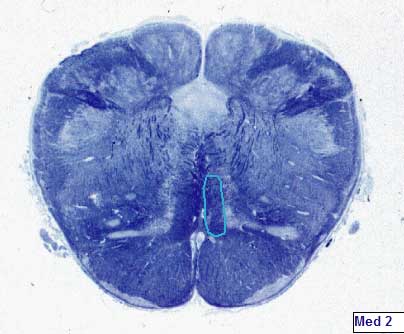
And they would ask you what findings would you find in a patient with a lesion in the highlighted area. So first you had to figure out that the highlighted area is the medial lemniscus, and then you had to remember that the medial lemniscus is where the proprioception and vibration fibers decussate (cross over) as they ascend. So a lesion there would cause contralateral (opposite side) loss of proprioception and vibration. This stuff was fascinating to me, and I did really well on the test.
| Lowest Score: 22.2% | Highest Score: 100.0% | Average: 85.3% |
May 8- Patient Diagnosis: I already shared my testimony about this test 2 posts ago. Despite the challenges, my wife and I both passed the test and the class. Tests in this class are cool because they make you feel like a doctor, but they are also stressing because a patient with dypsnea (shortness of breath) and chest pain, along with certain eye findings could have a host of stuff, and you have to really cycle through the differential diagnosis you have created in your head to solve the problem.
| Lowest Score: 49.1% | Highest Score: 94.0% | Average: 75.1% |
May 12- Anatomy & Embryology Final (In House): This test covered all of anatomy and embryology that we had be taught through the school year. The shear amount of information that the test could have covered was at first quite overwhelming. I wasted alot of my time trying to figure out how to study for such a huge test. I ended up settling on using a book called USMLE Road Map: Anatomy. It was not as dense as BRS, and had much better clinical correlates than High Yield Anatomy. I went through this book twice and took the test. I didn’t mention studying for embryology because I had honestly forgotten that embryo would be on the exam. But by God grace, most of the embryo on there I had already seen, so it wasn’t too bad. I did a little better than I expected and I attribute that to really hitting USMLE Road map hard before the finals.
| Lowest Score: 35.1% | Highest Score: 95.6% | Average: 76.1% |
May 13- Gross Anatomy Subject Exam (Mock Board): Once again, I reviewed USMLE Road Map: Anatomy, and the result was quite good. I got over my fear of standardized exams and realized that the mock boards are much different than the MCAT. In medical school, standardized exams are more about knowledge and less about “how to take the test”. I ended up getting 95% nationally on this exam! I’m not quite sure how to be honest. Maybe other people who are taking the test are construction workers or accountants. Either way, enough of them did poorly for me to do well, so I thank them:).
May 13- Gross Anatomy Practical Exam: This exam was tough because most people ( especially me) gave it little attention due to the studying that the bigger tests needed. This practical included the limbs, brachial plexus, the glueteal region, the pelvis, and the perineum. It was a tough test.
| Lowest Score: 18.0% | Highest Score: 98.0% | Average: 73.5 |
May 15- Cell and Molecular Biology (Mock Board): This was another one of those tests that scared the black off of me. It covered all the histology that we had learned from the whole school year. The second year medical students e-mailed us alot of advice on how to study for this exam, and every second year gave us different advice. Some said to study the High Yield Histology book, some told us to read through the text book for the class paying attention to all the bold words and pictures. I actually followed the advice of a 2nd year who told us that our teachers for histology had seen the mock board for many years, and they made sure that we learned everything in class that would be covered on the test. I was a little hesitant to do this because we had a serious stack of notes for the class, but I sucked it up and did it. This method really really worked for me. As I was taking the mock board, I would stop intermittently and praise the Lord that I went through the notes, because many questions were covered in class. Even when there was a question I was stumped on, it was because I could not remember what I had read in my notes. So this test went well, and I ended up getting 90% nationally on this exam. Once again, this is much better than I expected because I don’t do well on standardized exams, but I guess with better study habits and the grace of God, I’m getting a little better.
May 16- Understand Your Patient– Understanding your Patient is the title of the class, but basically the class is about Behavioral Medicine. Alot of our questions relate to what you would say to a patient in different clinical settings. For example:
A 9 year-old girl who has a terminal illness asks the physician, “Am I going to die?” The child’s parents previously told the physician that they do not want the child to know her diagnosis or prognosis. The physician’s best response to the child’s question is to say
a) “Do not worry, you will be fine.”
b) “Yes, you will die of this illness.”
c) “Tell me what your parents have told you about your illness.”
d) “Your parents do not want you to know about your illness so I cannot tell you.”
e) “Many children with this kind of illness live a long time.”
Many of the top students I know have a problem with this class because it has very little to do with knowledge and more to do with social interactions and least inappropriate answers. It is often possible to narrow the answer choices down to 2 answers which could definitely both be right. In those cases, you really have to remember how the teacher would have answered it…or as a last result, you choose the corniest answer and that is probably the right answer, lol. My dad was a social worker and he always came home telling us different stories. I guess my mind works like his slightly so I ended up doing pretty well on this test. This class is also crazy because you can get like a 92% on the test, and be in the 81% percentile for the test because so many people do well on it.
| Lowest Score:54.6% | Highest Score: 96.1% | Average: 80.0% |
May 16- Physiology: For the most part we had already finished most of the physiology for the year, so this test was our smallest physiology test of the year. It covered basically the physiology of the skin and a little cardio physiology that the teacher hadn’t covered before. I did pretty well on this test.
| Lowest Score: 50.0% | Highest Score:100.0% | Average: 86.2% |
May 19- Physiology Subject Exam (Mock Board): This test was just rough to study for. We were told that the best way to study for this exam was to really know BRS Physiology well. Well I kind of read through BRS Physiology twice (the first time I read every word and the 2nd time I went over what I highlighted). Through out the year I had been doing pretty well in Physiology class, so I hoped that that would help too. The 2nd years told us that we would feel like crap once the test was over…they were right. This mock board was the first one that I really didn’t finish. When they announced that we had 30 minutes left for the test, I was on question 80/125. Needless to say, I had to fly through the rest of the questions, not really being able to give each question the time it needed. I felt like the mock board tested similar concepts to what we learned in class, but the questions were so in depth that I just got confused after awhile. It also seemed like the test included a lot of pathophysiology which we had yet to learn. So yeah, I definitely felt like crap after this test. Even my friend who are ranked in the top 3 for our Physiology class said that the test made him feel like he didn’t know physiology at all. I’m sure he still did well anyway. I ended up getting 66% nationally on the exam. To be honest, I wanted higher, just because the Lord had blessed on the previous ones, but considering the way I felt after this exam, 66% is a blessing too :). I truly hope that the physiology is easier on Step 1, than the physiology on the mock board.
May 20- Biochemistry Final: It was so hard to study for this test. My body was darn near ready to shut down from exhaustion and I was ready to be done with it. This test was over all of the biochemistry that we had learned throughout the year. At first I planned to go through BRS Biochemistry, but I remembered that our Biochemistry teachers go over alot of stupid stuff that isn’t normally on the national exam, so it would be better in this sense to just go over all the notes. So I undertook the process and everything turned out pretty well. To be honest, Biochemistry has been my burden throughout the school year. Between Biochemistry and Evidenced Based Medicine, they are more lowest scores. Its good to realize your weaknesses in medical school and really work on it, because you don’t want to be lacking come Step 1 time.
| Lowest Score: 33.8% | Highest Score: 97.3% | Average: 80.1% |
So what you see above is the summary of my crazy test week. One thing I want to highlight is that for every test where I included the lowest, highest, and average score for the whole class, someone received a failing score for the test. Sometimes it is so easy to get caught up with your own score and how far away your score is from the highest score or the class average, but it is important to realize that on every test, one of your classmates failed it. Realizing this, I think it is important to stop worrying so much about ourselves, and instead to help those who may be struggling. While it is true that everyone needs to work hard individually to make it through, if God has blessed you with a gift in a certain or in all classes, you should use that gift to help others.
While I am happy to be done with tests, I am also saddened by the fact that some of my classmates will have to repeat the year. First year sucks, and I know that no one wants to do it again, but for some that is what will have to happen. I think that the best thing to do in these cases is to be as supportive as possible, and thankful because you could certainly be in their shoes.
So now that I am done with tests, I am in the hospital doing my first year rotations (something specific that Loma Linda SOM does). The 3rd year medical student I have been assigned to is currently on vascular surgery, and I think she will move to Anesthesia after that. My next post will describe my experiences so far on these rotations.
P.S.- I wanted to stress that I do not include my grades to boast…I am not a gunner. Just as I post when I do well on a test, I post when I fail a test too. Too often I think that medical students think that they are the only one that didn’t do well on a test. They look at the supposed super stars in their class and think that they don’t struggle. I am certainly not a superstar in my class but I do pretty well. Regardless of how well I do, I want those reading to know that you may have periods in school when you DO fail a test, or when you don’t score above the class average, or when you really do struggle with an entire class. But if they end result is a pass, then you have prevailed, and that is all that matters. You will still be a great doctor.
Wow, sounds like you had a crazy 2 1/2 weeks! I just finished my freshman year at Andrews University as a biology/pre-med major (Loma Linda is definitely a possibility), and have enjoyed reading your posts ever since I typed in “Loma Linda medical student blog” into Google when I needed some inspiration as some of my classes got tough. Your blog posts really energize me and motivate me to keep working hard and to keep my vision of becoming a physician a reality. Thank you for taking the time out of your very busy schedule to post.
-Luke
thanks alot for your encouragement look. Although I won’t be here when you get to LLU, I know you will do well, especially if you continue to keep God first.