
Test Week
You know, you would think that I was talking about finals week; but honestly this test week that we had was harder than my finals week last year. The sheer amount of information was amazing. Here is what it looked like:
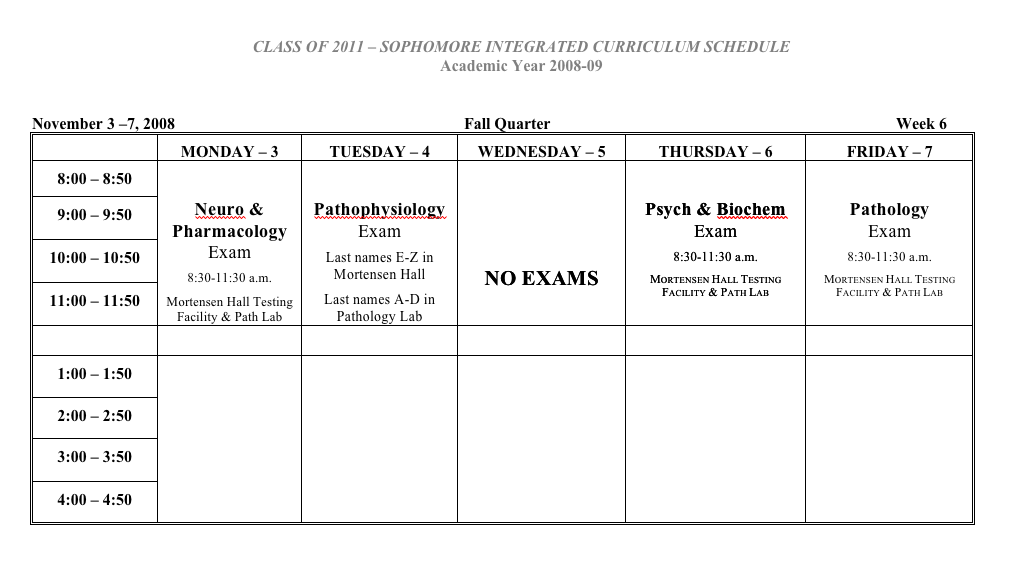
As usual, I’ll give you my breakdown:
Neuroscience: I truly do think that we have the best neuroscience teacher in America. When he speaks, you just understand. Regardless of this though the test required us to learn alot of new stuff. We learned about most of the movement disorders (Parkinson’s, Huntington’s, etc.), many of the dystrophies (myotonic, Beckers, Duchenne’s, etc.), neuropathies, etc.
Pharmacology: I knew my drugs. We had to know about 74 drugs involved with treating heart failure, angina, myocardial infarctions, dypsnea, cardiogenic shock, etc. Every drug that they had on our list I read about in the class notes and I knew them well. Unfortunately the teacher decided to take a majority of the questions from the assigned reading in the book (Katzung). So needless to say, this test was amazingly tough. I was so exasperated when I was done but its better to know why you didn’t do well. I knew that I had made the mistake of getting too busy and not reading the book. So next time I’ll do better.
Pathophysiology: The teacher for this class takes about 3 hours to write each question and you can tell because they are very detailed. Studying for this test took alot of time but it was worth it in the end. We basically had to know all the physiology behind heart failure, atherosclerosis, cardiomyopathies, etc. To pass this test you really needed to know all the ways the Frank-Starling curve and the pressure volume loop could change depending on the type of heart condition. The image below can widen significantly when a patient has chronic mitral regurgitation, or it can get tall and skinny when a person has aortic stenosis. 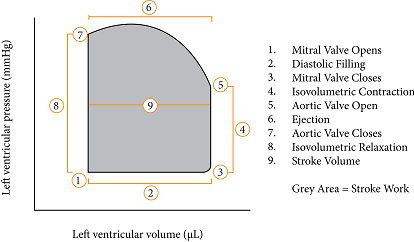
You also needed to know the different EKG leads that would pick up an MI involving the different coronary arteries, and a plethora more of info invovling the physiology of the heart. I’m not sure how I did yet, but I felt pretty good about the test. Alot of people said it was terribly rough so that scares me because I thought it was pretty fair, especially compared to how bad I had felt about the Pharm test the previous day.
Psychopathology: This test was an absolute beast. We had actually started to get lectures in this class at the beginning of the school year, but during our first test cycle we didn’t have any tests on it. Instead they saved all of their questions for this test. I think I got about 3 hours of sleep studying for this thing, but it turned out pretty well. We basically learned alot of the neurochemical physiology behind many of the psychiatric diseases like schizophrenia, obcessive-complusive disorder, etc. We also learned about the personality disorders (I think I have some Cluster C traits), and many other things.
Biochemistry: This class isn’t taught very well. I did much better than I felt after I took the test but I don’t feel like I’ll be very prepared for Step 1. I guess that its honestly hard to integrate biochemistry into a systems curriculum because many of the biochemical disease don’t fit neatly into a system. On this test we learned about the glycogen storage diseases, the muccopolysaccharidoses, trinucleotide repeats, etc.
Pathology: I really love pathology. But this class required a terrible amount of studying to get ready for, especially since it was our last test of the week and I was just ready to be done with it. On this test we had to know the pathology behind many diseases like temporal arteritis, sickle cell anemia, rheumatic fever, hypertrophic cardiomyopathy, etc., etc. etc. Basically if it involved the heart or the blood or the heart vessels we had to know all the diseases involved. Many people in my class read Rapid Review Pathology by Goljan to get ready for the test along with the class notes. I much more prefer to read the main textbook because when they are writing Step 1 questions, they aren’t looking in Rapid Review, but in the main text books like Robbins or Rubins. It takes twice as long but I truly feel like I have a deeper understanding.
We haven’t received all of our grades yet but so far I’ve passed everything which is truly a miracle.
A Day with the Chiropractor
Like most medical schools, Loma Linda University requires its medical students to spend time with health care providers in alternative medicine like chiropracty and accupuncture. About 3 weeks ago it was my groups turn to go to the Southern California University of Health Sciences. Of course I had a ton of stuff to study, and of course I wasn’t all that intereseted in learning how these crooks did their business but because many of my patients would be using their care in addition to mine, it was important for us to learn about them. So when I got to the school my view of them as crooks quickly disappated. These guys at this school were on point. Everything they practiced was backed up by research and hard science. They actually reminded me more of physcial therapists than chiropracters. They were very honest about what they could and could not treat. They were open in expressing how challenging it is for them because there were so many bad apples in their practice. To be honest I would definitely go to these guys for adjustments but the problem I have is that many of my patients won’t be going to chiropracters who were trained in such an evidence based practice school. My patients will be going to the folks that say they can cure their heart failure or their diabetes by a little back adjustment. Overall it was a great experience.
Drawing Blood
Like I said when I was talking about my Pathology test…we are learning all about the pathology of the heart, blood vessels, and the blood. So as part of that they had us choose a partner, draw blood on each other, do a blood smear, and look at our cells under the microscope. Of course the drawing of blood was the scariest part. If you were lucky enough to have a former nurse as your partner then you got a nice clean stick and not much pain. Unfortunately me and my wife were partners and neither of us had stuck anyone before. So yeah, terrible pain pretty much sums up what both of us felt as I stuck her and she stuck me but in the end some blood got into the test tube and we were able to do a nice smear.
So that pretty much sums up all the interesting stuff that has happened so far. I’ll try to blog alot more regularly.
Just a note on Pathology and from someone who has taken the USMLE step 1, Dr. Golijan is on point. I have even taken a board review with him. Pathology was my highest section on the exam and I say it is because of him. The way he words thing and the questions in his book are very close to what is on step 1. The audio even helps. So don’t give up on Rapid Review, just my opinion. The biochemistry Rapid review is also helpful for boards